Rescue Dog Owners on Tight Streets
You walk narrow pavements and blind corners where another dog can appear with no warning and no room to step aside.
A 59-page PDF guide that helps rescue dog owners plan safer neighborhood walks — with a before/during/after framework, a color-coded checklist, and a route and recovery worksheet.
Get the Guide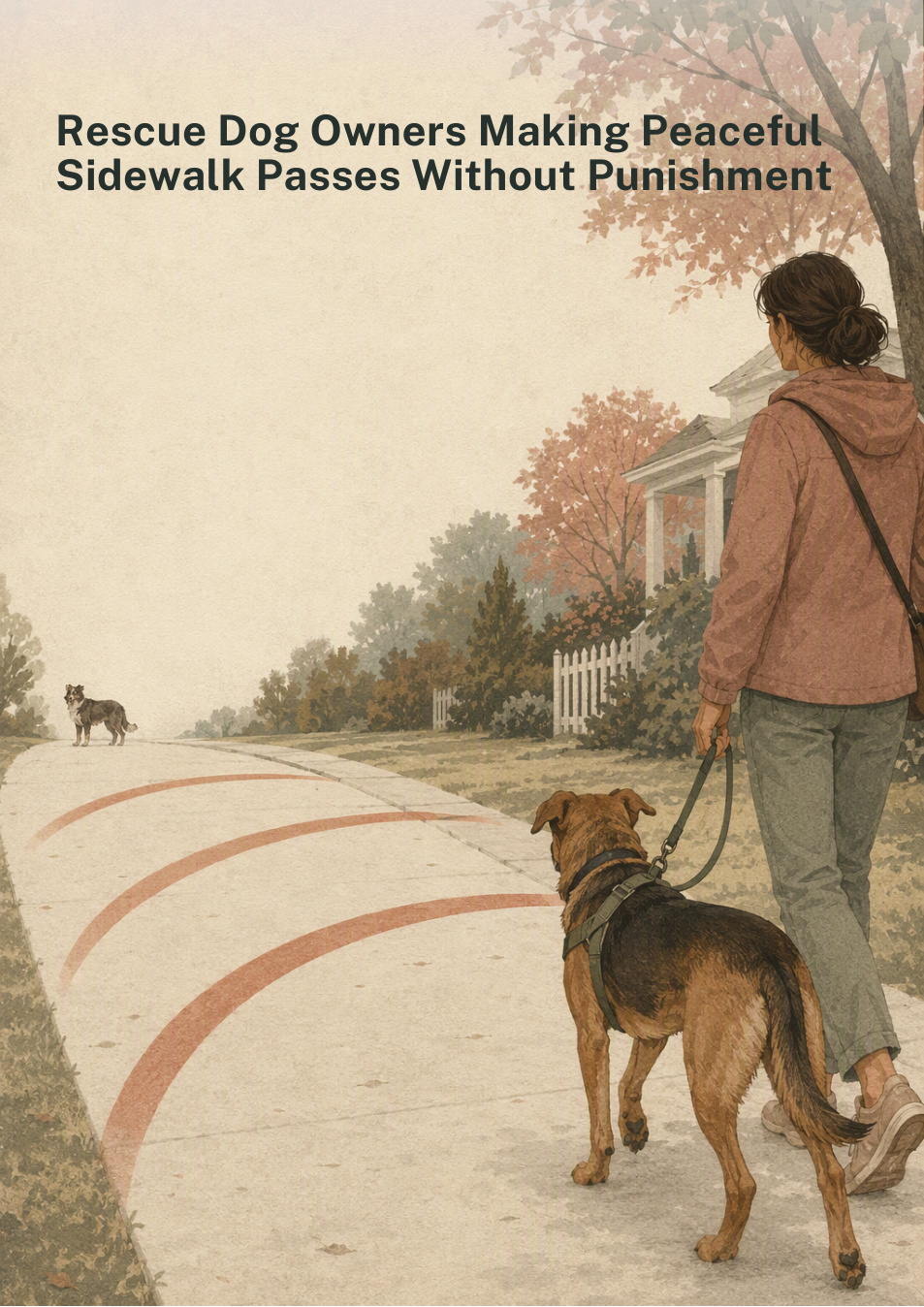
Another dog appears. You have two seconds and nowhere to go. A narrow pavement, a blind corner, a doorway — and suddenly you're out of options before you've had a chance to think.
Dog behavior has many causes. A dog may bark, lunge, freeze, or pull for medical reasons, past experience, or individual temperament. Street layout is one piece of the picture — not the whole story. But when the pavement is too narrow to step aside, when a building entrance blocks your exit, or when a busy traffic window leaves no quiet moment to pass — the environment makes every decision harder. That's worth planning for.
If your dog needs support beyond route planning — if there's pain, a bite history, a sudden change in behavior, or a situation you don't feel safe handling — a vet or a reward-based professional is the right next step. This guide works alongside that care, not instead of it.
Rescue Dog Owners Making Peaceful Sidewalk Passes Without Punishment is a 59-page PDF built around one narrow, useful idea: the decisions that shape a sidewalk pass happen before two dogs are ever close. Route choice, sightlines, available exits, and timing all affect what options you have in the moment.
The guide organizes those decisions into a before/during/after framework. Before the walk, you plan the route. During the pass, you use the Three Color Sidewalk Pass Checklist to notice distance-related behavior early. After, the Neighborhood Route and Recovery Worksheet helps you record what happened — so patterns become visible over time, not just stressful memories.
This isn't a behavior treatment. It's a management and planning aid. But when you know which corners are blind, which times are busy, and what your dog looks like when space is needed — you stop reacting and start deciding. That shift, from crisis to choice, is what the guide is designed to support.
You walk narrow pavements and blind corners where another dog can appear with no warning and no room to step aside.
You want a practical, reward-based approach — no punishment, no pressure, no shame for you or your dog.
You want a written guide you can read, revisit, and use on your own schedule — with tools you can bring on every walk.
Seven chapters built around one specific situation: another dog appears on your walk, and you need to decide what to do — fast.
The guide walks through route choice, reading the space ahead, noticing early signs of tension, and deciding whether to continue, create distance, or end the pass safely.
No punishment. No pressure to get closer.
Green, yellow, and red observation prompts to help you decide — in the moment — whether to continue, create space, or end the pass safely.
It is an observation aid, not a proximity permission or a validated behavioral test.
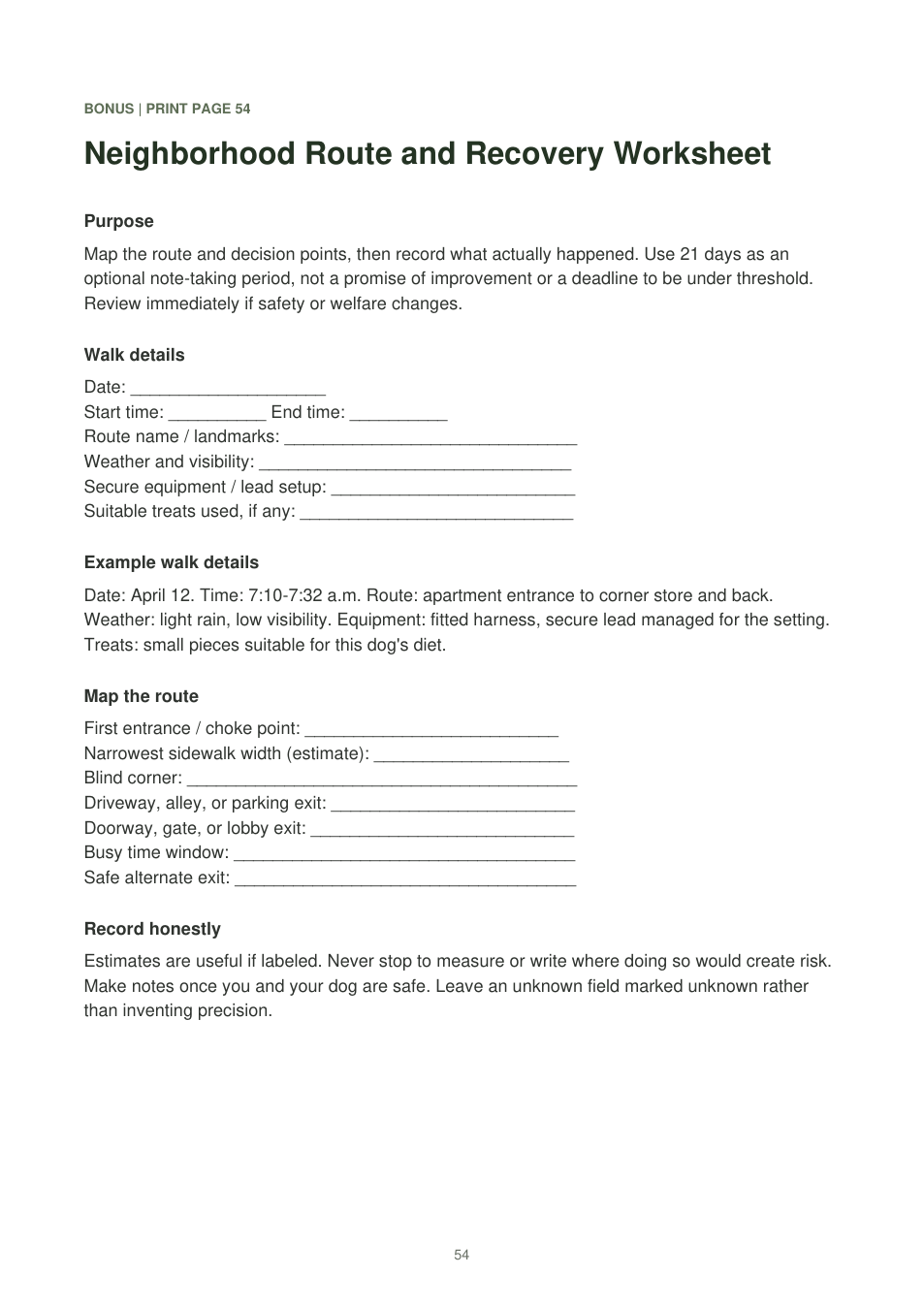
A printable sheet for noting your route, what you encountered, and how your dog recovered afterward.
Includes an optional 21-day record — a convenient window for observation, not a deadline or a promise of change.
The Neighborhood Route and Recovery Worksheet is a real, inspectable resource inside the guide.
A sample of the actual worksheet is shown below so you can see exactly what you are getting before you decide.
This guide starts earlier — at the route, the sightlines, the exits available to you before the other dog is near.
Pepe Becker built Calmer Rescue Dog Walks around that narrower focus: ordinary neighborhood walks, specific environmental constraints, and a repeatable framework for making decisions.
The result is a practical PDF — seven chapters, two named resources — designed for owners who want a clearer plan, not a shortcut.
If your dog has a bite history, shows new or worsening behavior, or you are not sure it is safe to handle the situation alone, a reward-based professional or your vet is the right next step. This guide is a planning and observation aid, not individualized care.
Rescue Dog Owners Making Peaceful Sidewalk Passes Without Punishment is a 59-page PDF you download once and keep. No subscription. No waiting for a parcel.
Seven chapters walk you through the decisions that matter before, during, and after a sidewalk encounter with another dog.
Two printable resources are embedded in the same PDF:
Print both at home on any standard printer. They are part of the PDF, not separate downloads.
This guide is a planning and observation aid. It does not replace a vet visit, a qualified reward-based trainer, or an individualized behavior plan — especially if your dog has a bite history, shows sudden changes, or is unsafe to handle. When those situations apply, please seek professional support first.
You pay once. The current price and any applicable tax are shown at checkout.
After purchase:
No subscription. No recurring charge. No separate bonus files to hunt for.
Questions about access or the product? Email support@pepebecker.com.
Get the GuideThis is an educational PDF. It gives you a framework for planning walks and observing your dog — it does not promise a specific behavior outcome or a fixed timeline for change.
Dog behavior has many causes. Route planning and distance management are useful tools, not the sole explanation for what your dog does. Some dogs need veterinary assessment or qualified professional support alongside any written guide.
If you have a question about whether the guide suits your situation before purchasing, email support@pepebecker.com and ask.
Your statutory consumer rights apply and are not limited by anything on this page. Where applicable law provides a right of withdrawal or refund for digital goods, those rights apply. Details are in the Withdrawal and Refunds policy linked in the footer.
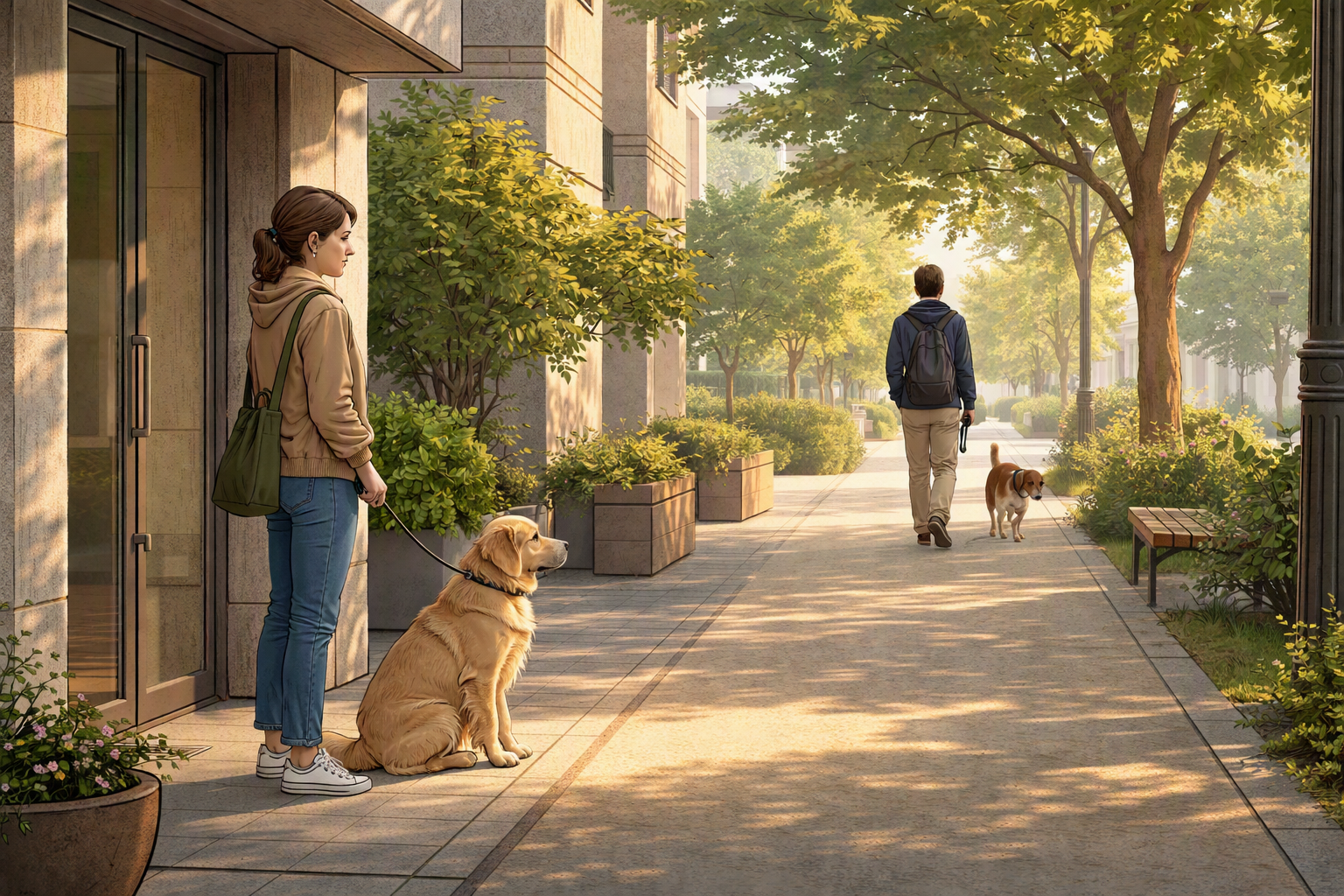
The scene below is illustrative. It describes handler planning choices only — not a predicted outcome for any dog.
You check the route before you leave. You know where the blind corner is. You know which side of the street gives you more room.
When a dog appears ahead, you notice early. You have already spotted a safe exit to your left. You choose it — calmly, before the gap closes.
That is what this guide helps you practice: reading the street before a situation decides for you.
This guide covers route planning, distance observation, and what to do during and after a sidewalk encounter. It is a self-paced PDF — not a training session, not a behavior assessment, and not a substitute for a vet or a qualified professional if your dog has a bite history, new or worsening behavior, or any sign of pain. If that kind of individualized support is what your situation needs, please seek it. This guide is for owners who want a clearer, more deliberate approach to ordinary neighborhood walks — and that is exactly what it delivers.
This guide is for owners who want a practical framework for planning neighborhood walks — things like route choice, sightlines, available exits, and what to observe when another dog appears on the pavement.
It is not a substitute for individualized professional care. If your dog has a bite history, is showing new or worsening behavior, may be in pain, or is not safe for you to handle, please work with a vet or a reward-based behavior professional before using any self-guided resource.
The guide is consistent with reward-based handling principles. Whether your dog accepts food during a walk depends on many things — arousal level, health, environment, and more.
Food refusal or acceptance has multiple causes. On its own, it is not a diagnostic indicator, and it is not proof that a situation is or is not safe. The guide helps you notice and interpret what you observe, rather than relying on a single signal.
The guide includes an optional 21-day observation record. That is a convenient window for tracking what you notice — not a promise that your dog's behavior will change within three weeks.
Every dog is different. This is a planning and observation tool. It does not replace an individualized assessment, and it does not set a timeline for outcomes.
Some encounters are hard to avoid — a blind corner, a narrow pavement, a building entrance with no room to move. The guide addresses exactly those situations: how to read the environment before you get there, what options you have in the moment, and how to end a pass safely when that is the right call.
Getting physically closer is not the measure of a good walk. A considered early exit is a valid outcome. The guide helps you plan for that possibility rather than be caught off guard by it.
On social pressure: other people's expectations are real, and the guide acknowledges that. Your dog's comfort and safety come first. Safe street crossings should always account for traffic and a safe destination before you move.
The guide focuses on the decisions that happen before two dogs are close — route planning, noticing early signs of tension, choosing distance, and observing what happens after. Those are things an owner can influence on an ordinary neighborhood walk.
Barking during a pass can have many causes. If the behavior is new, getting worse, or feels unsafe, a vet check and a reward-based behavior professional are the right next step — not a self-guided PDF.